IN THE DRC: INTERNATIONAL WOMEN’S DAY AT COPAK
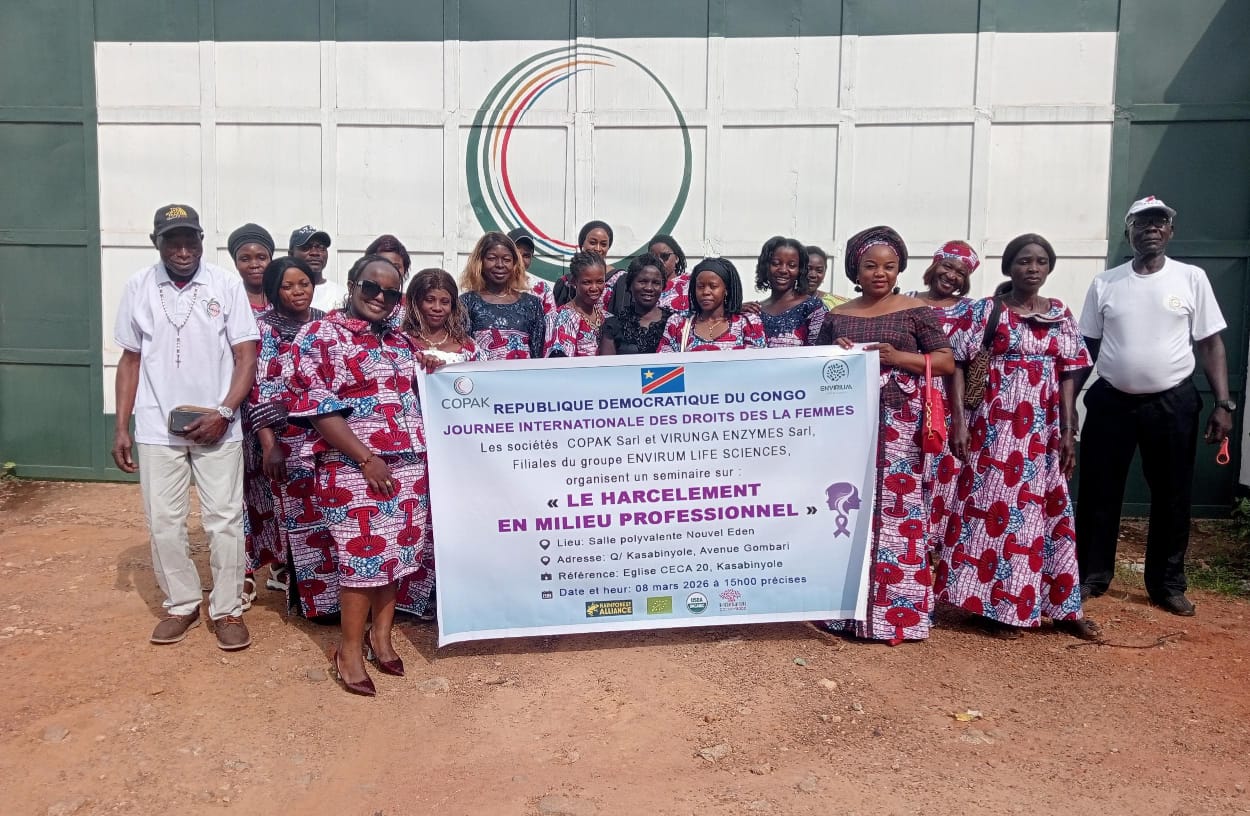
In the Democratic Republic of the Congo, March 8 is celebrated in a festive spirit: parties and church services are organized, and women receive pagne fabrics as gifts from their husbands and employers—a tradition that COPAK, a subsidiary of Envirium Life Sciences,wished to honor for its female employees and workers.
At COPAK, gender equality and respect for everyone’s rights have always been part of the company’s culture: “Since COPAK’s early days, women have been strongly represented—whether in leadership roles, or among our employees, our logistics staff, our agronomists, as well as our daily workers. In our hiring process, gender has never been a factor”, says Dimitri Moreels, Founder of COPAK and co-CEO of Envirium Life Sciences.
On the occasion of International Women’s Day, the COPAK team chose to focus on spreading prevention and awareness messages about harassment.
Our company is certified Cacao Trace and Rainforest Alliance. Inclusion, as well as respect for women’s rights, is therefore among the criteria for obtaining these international certifications: “Our goal with this training was to better inform our employees,” explains Maguy Anjelani, COPAK’s Head of Logistics. “The training was attended by all COPAK and Virunga Enzymes staff. We also invited partners and spouses, giving this event a broader scope. Our objective is to provide people with the tools to recognize the different forms of harassment and abuse of authority, and to know whom to turn to if a problem arises. Their role will now consist in sharing this information with all our colleagues and local partners.”
Led by an independent expert, the training generated strong interest and positive feedback from both women and men in attendance. “Thankfully, this is not the case at COPAK, but in our country some women are still forced to submit to sexual harassment in order to get a job. Each of us must play a role to ensure that women never again have to endure such abuse,” explains Rose Bisimwa. “This course was adapted to everyone’s level,” adds her colleague Bin Makuta Valaire. “The trainer discussed physical, psychological, and verbal abuse and explained how to respond when confronted with such situations.”